











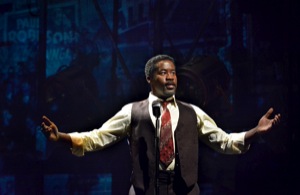
The La Jolla Playhouse has co-produced a few productions through the years with other notable regional theaters and with great success. This coming week they are bringing in a piece that is being co-produced with Kansas City Repertory and attached to that piece are the considerable talents of Daniel Beaty and Moises Kaufman.
The piece is The Tallest Tree in the Forest and is written and performed by Beaty and directed by Kaufman. The Tallest Tree is really a play with music that focuses on the life and times of actor Paul Robeson.
Robeson is best known for his work in the film Showboat and his rendition of “Ol Man River” is literally the quintessential version of the song. A song, thanks to Robeson, which has also gone on to be one of the most memorable songs in musical theater history.
While Robeson was probably best known for his theatrical and film work, he was also an attorney, an activist, a scholar and an accomplished athlete. He was born in 1898, and unfortunately had to endure life during the Civil Rights Movement, in which he became involved. His political involvement and his criticism of the U.S. government caused him to be blacklisted during the McCarthy era; but it was something he believed in and never backed down from.
Beaty and Kaufman have taken the life of this incredible man and have created a one-man show about that life. Both men have been drawn to Robeson’s life story for some time now and are thrilled to finally have the chance to bring that story to the stage.
Kaufman explained that it wasn’t just the story that intrigued him, but he also wanted to work with Beaty.
“First of all, I’ve been wanting to work with Daniel Beaty for a long time,” Kaufman said. “So when he approached me with this play, I was already predisposed to say yes. And then I read it. I think there were two things that drew me to Robeson’s story. First, the scope of his talent and his ambition. Robeson was a scholar and athlete, a singer, an actor and an activist. And his project was about art and about beauty and about race and about classes equality. So there’s something about the magnitude of that, which really inspired me. He was a ‘renaissance man’ and a ‘man of the world’ before our idea of ‘global’ existed. The second thing that attracted me to his story was that at one point in the 1940s he was the most famous black man in the world! And yet now, so much about him and his story have been erased from history!
Beaty, much like Kaufman, was also drawn to the fact that Robeson seems to have just been left out of the history books when so much of what he did deserves to be read about.
“Paul Robeson was like a superhero with the breadth of skills he mastered,” Beaty said. “I first discovered him when I was studying classical voice at Yale. At first I was astonished by the beauty of his voice. When I began to read more about him, I was shocked that he was not in the history books and that I did not know more about this major figure of American and world history.”
Beaty’s involvement with Kaufman on this piece stems from his admiration for the man, his work and also how he approaches and creates that work.
“This is my first time working with Moises,” Beaty confessed. “I admire [him] tremendously. I had been writing this piece for about a year when I reached out to him. We hit it off right away. We both have a relentless work ethic and passion for discovering the most complex, challenging and beautiful truths of a story.”
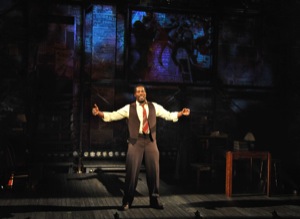
It may appear that Beaty likes to focus on only solo pieces but he admits that he has had just as much success with his ensemble pieces.
“I also write ensemble work and have actually had as many professional productions of my ensemble plays as my solo ones,” Beaty admitted. “There is something about the solo form that highlights the magic of storytelling; the ability of one performer to inhabit so many types of people that intrigues and inspires me.”
In The Tallest Tree, Beaty tackles more than 40 different characters, including Robeson, and sings 15 spirituals. Kaufman finds that to be his favorite thing about the show and admits that he is “in love” with Beaty’s virtuosity.
Kaufman, also an accomplished playwright, found that the historical nature of Robeson’s life was somewhat familiar territory and in some ways a challenge to work on.
“I have created and directed several works that depict historical characters (Gross Indecency: The Three Trials of Oscar Wilde; The Laramie Project; I Am My Own Wife) so that part of it felt familiar,” Kaufman said. “But what really challenged me was the magnitude of the man’s project. Robeson realized that his fame gave him a platform that his race needed in their fight for civil rights at that time, and he had to make a decision between being an activist or being an artist. And he couldn’t do both. A lot of the play deals with that decision.”
The Robeson story seems to be something that has been begging to be told and in the more than competent hands of Beaty and Kaufman, it is sure to pull a few heartstrings and could possibly be Broadway bound. However, the possibility of that is something that both Kaufman and Beaty would rather not think about at the moment.
“I have learned it is healthiest for me to focus on doing the most dynamic work I can each and every night and try to release my expectations of what will happen in the future,” Beaty admitted. “But, yes, taking this piece to Broadway would be a dream come true.”
What Beaty and Kaufman hope to accomplish with The Tallest Tree is to shed light on what an amazing man Robeson was.
“I would love for people to have a full, multilayered portrait of who Robeson was,” Beaty said. “And whether or not they ultimately agree with the choices he made, I hope they will have a rich understanding of why he made those choices, the fearlessness of his decisions, and the complexity of the time period in which he was living.”
Kaufman, on the other hand, raises a few questions that audiences may possibly be asking themselves after the show.
“As both a playwright and a director I’ve often done works that have strong social and political questions and implications,” Kaufman stated. “So I too have to ask myself, why am I an artist? Should I be an activist? Is the best way I can be an activist by continuing to create? Or would my mind and talents be better used by becoming a politician/activist? And in this sense this play spoke to me. Robeson dealt with these questions head on. In his own words: ‘The artist must take sides. He must choose to fight for freedom or for slavery. I have made my choice’. It’s important to ponder this.”
The Tallest Tree in the Forest opens Oct. 11 and will close Nov. 3. For tickets call the La Jolla Playhouse box office on 858-550-1010 or visit lajollaplayhouse.org


