








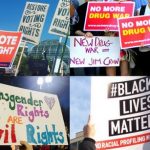
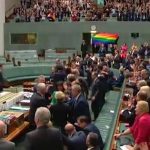

Sometimes progress doesn’t fit on a bumper sticker. “Congress Repeals Don’t Ask Don’t Tell” will always be a sexier sound bite than “Attorney General Holder announces that the Department of Justice (DOJ) will no longer defend Section 3 of the Defense of Marriage Act (DOMA).” Make no mistake, though, President Obama’s decision not to defend DOMA may prove just as large of a step toward LGBT equality. It just requires a bit more explanation, so here is your primer.
What’s DOMA?
DOMA was passed by Congress in 1996 and signed by President Clinton. At that time, there was a fear that Hawaii would allow same-sex marriage and other states would have to accept them. DOMA has three Sections. Part 1 is the title; Part 2 says that states don’t have to recognize same-sex marriages performed in other states; Part 3 says that the Federal Government only recognizes marriage between a man and a woman.
Why do I care about DOMA?
If you have a same-sex marriage recognized by your state, DOMA is why you can’t file joint federal income tax returns, deduct your partner’s health care premiums or enjoy more than 1,000 other federal benefits to which married couples are entitled. In California, DOMAs impact is most felt by the 18,000 married same-sex couples.
What happened?
Just as many feel that Governor Brown should defend Proposition 8, President Obama and the Department of Justice had argued it was their duty to defend DOMA in court, despite advocating its repeal. Some of the arguments proffered were downright incendiary, comparing same-sex unions to incest and pedophilia.
Last week, U.S. Attorney General Holder officially informed Congress, and certain courts, that the DOJ would no longer defend Section 3 of DOMA in court. (There was no impact on Section 2.)
What didn’t happen?
Sadly, same-sex couples didn’t suddenly get federal benefits. Just as DADT remains in effect until certain hurdles are overcome, DOMA is still the law of the land, and President Obama has promised to continue enforcing it.
Thus far, the judges who have ruled DOMA unconstitutional have stayed their decisions pending appeal. Until a federal judge or an appellate court lifts that stay, or the U.S. Supreme Court makes a final decision, we’re stuck with DOMA.
Why now?
Progressive activists say their fervor finally scared, or moved, the President. Cynics say this is a cold calculation by President Obama to raise LGBT money for his 2012 campaign. Neither are likely or entirely wrong, but there is actually a subtle, but compelling legal reason to dump DOMA, related to “scrutiny.”
Most laws can be painted as discrimination against some group: property taxes against home owners, speed limits against speeders. Since you could choose not to own property, or speed, the government needs only a “rational basis,” like raising money, to pass laws affecting your group.
The rules change when a group is defined by unchangeable characteristics, has been discriminated against and has lacked political power. The California Supreme Court decided the LGBT community is such a group, called a “suspect class,” and applied “strict scrutiny,” a tougher standard than “rational basis.” Strict scrutiny required California to show a truly compelling reason to discriminate against same-sex couples. Since there wasn’t one, the court ruled in favor of same-sex marriage.
To prevent laws from changing annually, courts uphold precedents. The early cases against DOMA were in courts with a precedent that the LGBT community was not a suspect class, so the DOJ could use any rational basis, even just preserving the status quo, to defend DOMA.
So … why now?
Smart allies filed in a district with no precedent on scrutiny, and the deadline on one of those cases was March 11. To defend DOMA, the DOJ would have to argue that homosexuality is a choice, or that same-sex couples are inferior. As those conclusions are not supported by facts, there was a compelling new reason to change their policy.
What’s next?
The DOJ’s new stance may have the least impact in federal cases. Most legal experts believe that conservatives in the U.S. Congress can defend DOMA, so it stands until a court, possibly the Supreme Court, finally invalidates it.
The new stance may have more power at local levels, where the DOJ policy can be used to represent a change in the status quo. Hours after the policy was announced, the plaintiffs in Perry v. Schwarzenegger asked the appeals court to restart same-sex marriages in California. Their argument: if the DOJ thinks that heightened scrutiny applies to our community, Proposition 8 is so unlikely to stand that the court should err on the side of equality until they make their final decision.
The DOJ opinion may also bolster the idea that the LGBT community, like racial and ethnic minorities, is entitled to special consideration when redrawing voting districts.
Who do I thank?
Everyone. If you’re politically active in any way, pat yourself on the back. As with the repeal of DADT, we will never know what was based on insider action, what was won by public pressure and what was a change of heart. What we do know is that the only people smiling when we fight with each other are the forces of inequality. Toast the pending doom of DOMA with someone who fights in a different way, and promise to continue the march toward equality together.


